


988 and New Crisis Center
Review by Susan Esquilin, Ph.D., ABPP and Hazeline Pilgrim, LSW
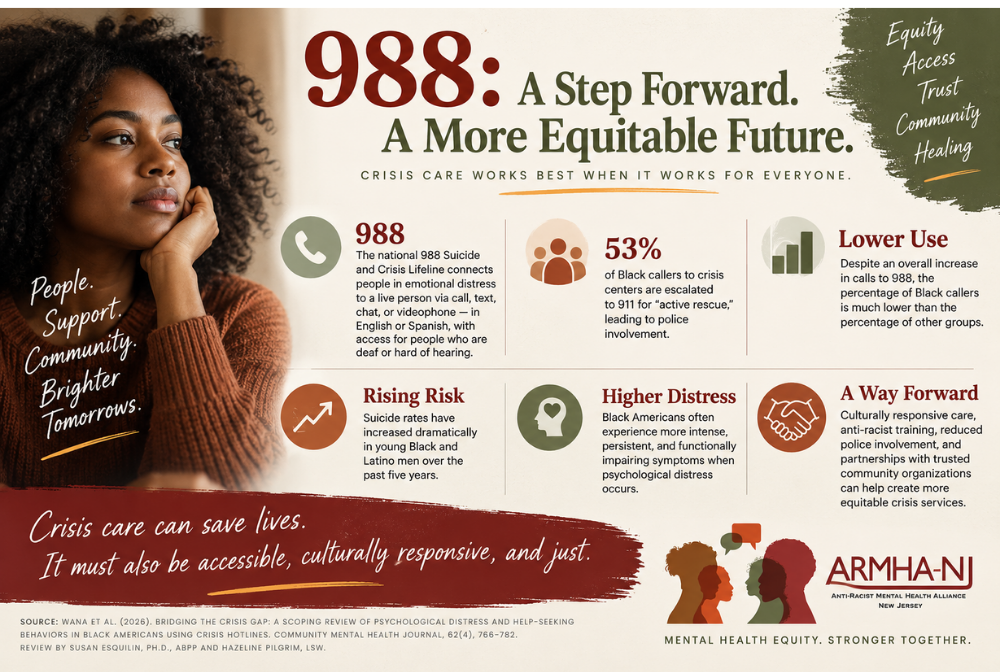
In the spring of 2025, NJ began the statewide use of a new national 988 Suicide and Crisis Lifeline for people in suicidal crisis or emotional distress. When people call 988, they are connected to a live person who listens, offers support, and shares helpful resources. People can reach 988 via videophone, call, text, or chat. Callers may use English or Spanish, and services are available for those who are deaf or have a hearing loss. A staff member will engage the caller in any of these ways. All these discussions are confidential. The goal of 988 was to create a supportive public mental health intervention, not just primarily a public safety involvement. Thus, the role of the crisis center is seen as helping clients identify and find the kinds of services they need and bridge the gaps that exist.
Most recently, an addition to the existing 988 program was added in April 2026, when the first of five crisis centers in the state opened in Newark at Rutgers University Behavioral Health Care. It houses a short-term (under 24 hours), community-based support for individuals experiencing suicidal, mental health, or substance use crises. Services will be available to everyone, regardless of ability to pay.
Race and Use of Crisis Units
Mental health statistics reveal that White people in the US have the highest rates of mental illness over the course of their lives than other racial groups. However, the level reported of distress by Black and Latino people related to experienced discrimination and racial bias is extremely high. The authors state that “Black Americans often experience more intense, persistent, and functionally impairing symptoms when psychological distress occurs, even when the overall prevalence of mental illness is comparable to or lower than other groups.” Thus, people in crisis may not be manifesting a mental illness diagnosis as is typically understood. People in crisis may be reacting to acute or chronic life stress that is due to discrimination, financial strain, or limited access to early or preventive care. Clients in this situation often delay seeking help and present to crisis programs with symptoms that are not fully understood by staff.
The 988 program developed in response to the increase of suicidality in the last five years. In particular, the rates of suicide have dramatically increased in young Black and Latino men. However, while this program has produced a significant increase overall in calls, support, and help, the percentage of Black callers is much less to 988 hotlines than the percentage of other groups. The authors of this article outline key issues that have a role in this finding:
Crisis centers escalate more of the calls of Black clients to 911 for “active rescue”, and therefore police involvement occurs in 53% of Black clients.
In general, there is mistrust of formal mental health systems, and Black clients
are more likely to seek help from personal and family networks.
Many crisis centers are struggling with structural and staffing problems, predominantly in counties with large Black populations.
Racial differences in help-seeking patterns remain, as Black adults are more likely to recommend calling 911 or going to an emergency room rather than using a crisis hotline. Research suggests that there is doubt about the effectiveness of these programs.
Cultural issues play a major role in these outcomes, as do historical factors. There is stigma associated with both racial identity and mental health problems, suggesting feelings of shame that lead to resistance to getting help. In addition, there is considerable mistrust of mental health providers due to historical medical racism (e.g., the Tuskegee experiment), and particularly discomfort about engaging with White providers. Black clients often distrust the promise of confidentiality, and they often experience the White clinician as unable to understand their life perspectives. A particular fear exists related to fear of police involvement, as often happens when a crisis center notifies 911.
The authors of this article believe that the hotline services do not address community mistrust and cultural concerns. Further, the authors point out that the resources for crisis-stabilization beds and programs are inadequate, particularly in communities with large Latinx populations.
More attention must be paid to notifying the public about the presence and work of the crisis centers. The authors suggest these centers should provide ongoing connection to care and not just a de-escalation of the crisis. These centers need to be more sensitive to issues of confidentiality and mistrust, minimize police involvement, and expand their outreach into trusted and culturally familiar institutions. The authors further suggest that anti-racist training is necessary for crisis staff. As many Black clients turn to informal networks, the authors also recommend that crisis services should “collaborate with, rather than replace” existing community-based response networks.
Going Forward
The crisis hotlines and the new crisis centers hopefully will open more options for people in emotional distress to get the kind of care they need. It would be important to bring in local resources (e.g., faith-based organizations, fraternities and sororities, educational institutions using the community schools approach) that are not now identified as mental health resources to work in concert with the hotlines and crisis centers, so as to diminish stigma and enhance cultural relevancy. It is particularly important for the provider community as well as community resources and the community at large to be educated about mental health symptoms and concerns in non- white populations, including crisis reactions. ARMHA-NJ has the capacity to help educate the community about these issues through our general community outreach. We would eagerly welcome people to join us in these efforts.
Wana, G. W., Sarker Rony, S. K., Hasan, M. R., & Combs, R. M. (2026). Bridging the
crisis gap: A scoping review of psychological distress and help-seeking
behaviors in Black Americans using crisis hotlines. Community Mental Health
Journal, 62(4), 766–782. https://doi.org/10.1007/s10597-025-01569-3
If you are passionate about creating a mental health system that is anti-racist, equitable, and accessible, please join us! You will find a supportive and passionate alliance of individuals ready to walk this path with you. Step by step, together, we can dismantle racism in our mental health system and in our world. Join us today and be a part of the change we wish to see!


Comments